

Explained simply
How Online Casinos Work
RNG, RTP and house edge in plain Kiwi English, with real NZ$ numbers and a simulator to try.
- 1994Gaming Club online sinceSince
- 97.48%Published average payoutPayout
- 1,500+GamesGames
- NZ$10Min depositMin dep
What an online casino actually is
Strip away the music and the flashing lights, and an online casino is a licensed business running a website and an app where you bet on games of chance. Understanding how online casinos work starts with the people involved. The operator holds the licence, runs the cashier and pays you out. Gaming Club, for example, is run by Baytree Interactive Ltd under Kahnawake Gaming Commission licence 00892, and Baytree (Alderney) Limited holds a second licence, 155 C1, from the Alderney Gambling Control Commission. The rules for New Zealand players are covered on our legality page.
The games are built by separate studios such as Games Global and Pragmatic Play. When you open a pokie, the reels are drawn on your screen, but the result is worked out on the studio's game server, not on your phone.
Your money sits in two places. The cash balance holds what you deposited plus anything you won with it. The bonus balance holds bonus credit, which has to be wagered before it turns into cash; Gaming Club's welcome match carries 35x wagering. Loyalty points you swap for Bonus Credits land in the bonus balance too.
And the casino gets paid the same way a land-based one does: through the house edge. Every game is designed to return a little less than it takes in. The casino doesn't need you to lose on any given night. It needs thousands of players spinning, and the maths does the rest. The brand itself is covered in our Gaming Club review.
From deposit to withdrawal: the journey of one NZ$20
The clearest way to see how online casinos work is to follow a single NZ$20 deposit at Gaming Club through the whole loop.
- Sign up & verifyName, address, age 20+, ID when asked
- Deposit NZ$20Card, Apple Pay or e-wallet, lands almost instantly
- Pick a gameA NZ$0.50 pokie gives you 40 spins
- RNG decides the spinThe result is fixed the moment you press spin
- Balance updatesStake taken, any win added, round by round
- Withdraw24-hour pending, then paid to your method
Illustrative example based on Gaming Club's published cashier rules.
Say those 40 spins end with NZ$26 in the cash balance and you ask for it back. Gaming Club holds every withdrawal in a 24-hour pending period first, and withdrawals are not processed at weekends, so a request made on a Friday evening waits for Monday to move. After that, the method sets the pace: Skrill, Neteller and ecoPayz usually pay within 24-48 hours, while Visa takes 2-6 business days. Mastercard and Paysafecard are deposit-only, so anyone who funded with either picks another route to cash out.
If you had claimed the welcome match on that NZ$20, you would also have NZ$20 of bonus credit, and 35x wagering means NZ$700 of bets before it converts. One banking tip: some New Zealand banks treat card payments to casinos as a cash advance, with a fee and interest from day one, so a debit card or an e-wallet is the calmer choice.
How online casinos work, with real numbers
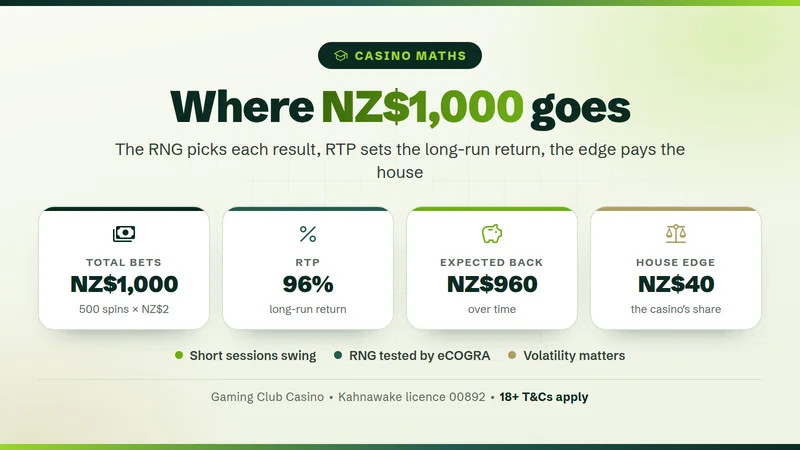
The one number that explains most of it is RTP, or return to player: the share of all money staked on a game that the game is designed to pay back over a very large number of rounds. A pokie with 96% RTP keeps 4% on average, and that 4% is the house edge. Here is the house edge explained through an online casino NZ$ example: 500 spins at NZ$2 each.
- NZ$1,000Total bets (500 × NZ$2)
- 96%Game RTP
- NZ$960Expected back
- NZ$40House edge
Put NZ$1,000 through a 96% pokie and the long-run expectation is NZ$960 back and NZ$40 kept by the house. That doesn't mean NZ$960 in your pocket at the end of the night. It means that if thousands of players each did exactly this, their average would land very close to NZ$960.
Notice too that NZ$1,000 is turnover, not a bankroll. Winnings get re-staked, so a NZ$100 balance can easily push NZ$1,000 through a game in an evening. The house edge works on every dollar that goes round, not just the dollars you deposited.
Why your session won't look like the average
Short sessions swing wildly. Over 500 spins one bonus round can put you well ahead, while a dry patch can take the lot. Both are normal, and neither tells you anything about the game's RTP.
How far the swings go depends on volatility. Low-volatility pokies pay small wins often; high-volatility ones pay rarely but bigger. Progressive jackpots such as Mega Moolah sit at the far end: part of every stake feeds the jackpot, so a slice of the RTP is locked up in a prize very few players hit. The average only shows up over thousands of spins, which is the casino's time frame, not yours.
Try it: a spin simulator with your own numbers
Move the sliders to set a stake, a number of spins and a game's RTP. It starts on the example above: NZ$2 a spin, 500 spins, 96% RTP.
Then try dropping the RTP from 96% to 94% with everything else the same. The expected cost jumps from NZ$40 to NZ$60, half as much again for two percentage points.
The takeaway: expected cost is total staked times the house edge, and bonus wagering works the same way. A NZ$100 match at 35x means NZ$3,500 of bets, and at 96% RTP that turnover has an expected cost of about NZ$140. Game choice matters here as well, because at Gaming Club pokies count 100% towards wagering while most table games count only 8%. Our VIP program guide shows how wagering and loyalty points stack onto your turnover.
Myths Kiwi players still believe
This pokie hasn't paid for ages, so it's due.
FactEvery spin is independent. The RNG has no memory of the last spin or the last hundred, so a long dry spell doesn't make a win any more likely on the next one.
The casino tightens the games when you're winning.
FactRTP is set by the studio in the game's build and checked by independent auditors such as eCOGRA. The casino can't nudge your odds up or down in the middle of a session.
A bonus is free money.
FactBonus credit sits in its own balance and has to be wagered before it becomes cash, 35x on Gaming Club's welcome match. It buys extra play time, not a guaranteed payout.
Playing late at night pays more.
FactTime of day makes no difference. The RNG and the RTP are the same at 3am as at 3pm, on a quiet Tuesday or on payday.
Live dealer games are pre-recorded.
FactLive tables are streamed in real time from studios run by providers such as Pragmatic Play and OnAir. The dealer works to the betting window you see, and a new round only starts when it closes.
A betting system can beat the RNG.
FactDoubling after a loss, or any other pattern, only changes how your bets are sized. The house edge stays the same on every one of them, and doubling runs into your balance or the table limit surprisingly fast.
Why this matters when you play
Knowing how online casinos work won't turn the odds your way, but it does stretch the same budget further.
Pick higher-RTP games
Two pokies can look alike and differ by a few percent in RTP. Check the info screen first; over a long session a higher RTP means your balance lasts longer.
Match volatility to your budget
A small balance on a high-volatility game can be a very short night. Low-volatility pokies stretch money further; the wild ones suit players happy to sit through dry spells.
Read wagering before you claim
35x on the bonus, pokies at 100%, most tables at 8%. Working out the turnover up front tells you whether an offer suits the way you like to play.
Who makes the games at Gaming Club
Gaming Club doesn't build its own games. Like every large online casino, it licenses them from studios and runs them on its platform. Games Global, the company behind the old Microgaming catalogue, supplies nearly every top pick in the New Zealand lobby, and a handful of partners fill out the rest of the more than 1,500 pokies, table games and live dealer titles.
 Games GlobalMost pokies and jackpots
 Pragmatic PlayPokies and live game shows
 OnAirLive dealer tables
 ApricotPlatform partner
Fairness is checked outside the casino. Gaming Club carries the eCOGRA seal, so its games are independently audited, and the casino has published an average payout of 97.48%. Progressive jackpots such as Mega Moolah pool a slice of every stake across a network of casinos into one growing prize, which is how that jackpot can climb far past what a single site could fund. The about page has more on the brand's history since 1994, or you can open Gaming Club and check any game's info screen for its RTP.
Who online casino play is not for
Worth saying plainly: how online casinos work comes down to paid entertainment with a built-in cost. The house keeps a margin over time, so the only sensible budget is money you would happily spend on a night out.
- Anyone under 20. Gaming Club's New Zealand terms set the minimum age at 20.
- Money meant for bills. Rent, power, groceries and loan repayments are never a bankroll.
- Chasing losses. Trying to win it back raises your turnover, and the edge works on every extra spin.
- Expecting an income. The long-run maths runs against every player; no system makes pokies a side hustle.
- Feeling pressure to play. Logging in out of habit, boredom or stress is a cue to step away.
- A friend or whānau is worried. That is often the earliest sign, and worth listening to.
Gaming Club offers daily, weekly and monthly deposit limits, self-exclusion periods, a self-assessment questionnaire and activity reports, and the live chat team can point you to them. Free, confidential help in New Zealand is available from the Gambling Helpline and the Problem Gambling Foundation.
Questions about how online casinos work
QHow do online pokies work?
An online pokie is a program running on the game studio's server. When you press spin, a random number generator picks the result, and the reels on your screen simply animate to show it. The paytable and the game's RTP decide how often, and how much, winning combinations pay over the long run. How fast you tap or the time of day changes nothing.
QWhat is RTP?
RTP stands for return to player. It is the percentage of all money bet on a game that the game is designed to pay back over millions of rounds. A 96% RTP pokie returns NZ$96 for every NZ$100 staked on average, and the missing 4% is the house edge. The studio sets the figure, usually listed in the game's info screen.
QIs RTP the same as my chance to win?
No. RTP tells you how much comes back on average, not how often you win. Two games with the same 96% RTP can feel completely different: one pays small amounts on lots of spins, the other goes quiet for long stretches and then lands something big. That difference is volatility, and it shapes a single session far more than RTP does.
QWhat is an RNG and who tests it?
A random number generator is software that produces an unpredictable stream of numbers, many times a second, which the game turns into reel positions, cards or roulette pockets. Independent test labs check that the output really is random and that games pay back what they are built to. Gaming Club carries the eCOGRA seal, which means its games are independently audited.
QAre online casinos rigged?
Reputable ones are not, and they have no need to be: the house edge already gives them a steady margin on every bet. Gaming Club is licensed by the Kahnawake Gaming Commission (licence 00892) and the Alderney Gambling Control Commission (licence 155 C1), and its games are audited by eCOGRA. A bad night is usually just ordinary variance.
QWhy do I need to verify my account?
A licensed casino has to confirm who you are, that you are old enough (at least 20 for Gaming Club players in New Zealand) and that the money you play with is yours. Expect to be asked for photo ID and proof of address, and sometimes bank statements or payslips. Sending them early keeps your first withdrawal moving.
QHow long does a withdrawal take in NZ?
At Gaming Club every withdrawal first sits in a 24-hour pending period, and none are processed at weekends. After that, Skrill, Neteller and ecoPayz usually arrive within 24-48 hours, while Visa takes 2-6 business days. The cashier works the same in the mobile app and the browser, so you can request a payout from your phone.

See the maths at work
Now that RTP, volatility and wagering make sense, every game info screen and bonus term reads a lot more clearly. New players at Gaming Club start with up to NZ$350 across two deposits, and the free loyalty programme adds 2,500 points after the first one.